


As professionals working in landscaping, road construction, and site development, we understand that long-term performance often depends on details that are easy to overlook. One of those details is concrete curbing. Whether it is used in residential landscapes, commercial properties, municipal roads, or highway projects, concrete curbs play a critical role in defining space, improving durability, and maintaining order on site.
Over time, we have learned that traditional curb construction methods no longer meet modern project demands. That is why investing in a concrete curb forming machine has become a practical decision for contractors who value efficiency, consistency, and long-term cost control. This article explains why we believe a concrete curb forming machine is worth purchasing and how it supports sustainable project delivery.
Concrete Curb Forming Machines Support Long-Lasting Concrete Curb Construction
Concrete is widely used for curbs because of its durability. Compared with wood, plastic, or segmented prefabricated units, cast-in-place concrete withstands weather exposure, moisture, and repeated mechanical stress far more effectively.
When we use a concrete curb forming machine, curbs are produced continuously on site rather than assembled from individual pieces. This creates a unified structure with fewer weak points. Over the long term, this improves stability, reduces cracking at joints, and helps curbs maintain their shape and alignment. For clients, this means fewer repairs and consistent performance over many years.

Low-Maintenance Concrete Curbs Add Practical Value for Clients
One of the most common requirements from property owners and municipalities is low maintenance. Once concrete curbs are properly formed and cured, they require minimal ongoing care. There is no need for frequent repainting, staining, or replacement.
By relying on a concrete curb forming machine, we can deliver curbs that meet these expectations. Reduced maintenance benefits not only the end user but also contractors. Fewer post-installation issues mean fewer callbacks and a more predictable project lifecycle. This reliability helps strengthen long-term client relationships.
Concrete Curb Machines Improve Weed Control and Soil Retention
Concrete curbs are not only decorative or structural elements. They also play an important role in site management. Properly formed curbs act as barriers that help retain soil and limit weed growth along garden beds, road shoulders, and landscaped areas.
When curbs are formed directly on site using a curb forming machine, the contact between the curb and the ground is more consistent. This reduces gaps that allow weeds to grow or soil to erode. As a result, landscapes remain cleaner, and maintenance demands are reduced over time.
Increased Efficiency with Slipform Concrete Curb Forming Technology
Traditional curb construction often involves multiple steps, including prefabrication, transportation, manual placement, and alignment. Each step increases labor input and introduces potential quality risks.
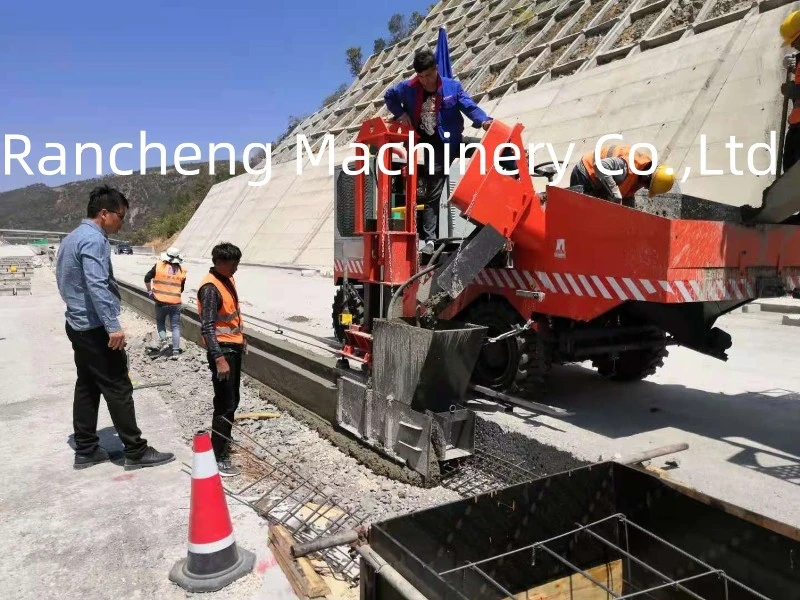
Slipform concrete curb forming machines streamline this process. Concrete is continuously supplied, compacted through vibration, and shaped by the mold as the machine moves forward. This allows long sections of curb to be completed in a single, uninterrupted operation. On large-scale or time-sensitive projects, this efficiency can significantly shorten construction schedules.
Reduced Labor Requirements and Better Cost Control with Curb Forming Machines
Labor availability remains a challenge across the construction industry. A concrete curb forming machine reduces reliance on large crews by automating key parts of the forming and compaction process.
With fewer workers required for curb installation, labor costs become easier to control. At the same time, consistent machine operation reduces material waste and rework. From our experience, this combination leads to more stable project budgets and improved overall profitability.
Rancheng Group Concrete Curbing Machines
Maintaining straight lines, uniform height, and smooth curves can be challenging when curbs are built manually or assembled from prefabricated blocks. Minor inconsistencies often become noticeable, especially over long stretches.
The Rancheng Group concrete curb machine offers precise control over curb geometry. Its internal vibration system ensures thorough compaction, while the guided movement maintains accurate alignment throughout the process. As a result, the curbs have a clean, continuous profile that enhances both appearance and structural performance, making them suitable for landscaping, roadways, and large infrastructure projects.
Flexible Applications Through Interchangeable Concrete Curb Molds
One of the strongest advantages of a concrete curb forming machine is flexibility. By changing molds, the same machine can produce a wide range of curb shapes and sizes.
This flexibility allows us to handle different applications using one piece of equipment, including decorative landscape curbs, municipal road curbs, shoulders, gutters, and low concrete barriers. Curves and transitions can be formed directly on site, reducing the need for redesign or additional tooling. This adaptability supports a broader range of project requirements.
Key Benefits of Using a Concrete Curb Forming Machine
• Continuous on-site production without prefabrication
• Reduced labor demand and simplified crew organization
• Uniform strength, alignment, and surface finish
• Adaptability to different curb profiles through mold replacement
These benefits make concrete curb forming machines suitable for both landscaping contractors and infrastructure builders.

Why We Choose Concrete Curbing Machines
From a business perspective, purchasing a concrete curb forming machine provides greater control over production and scheduling. It reduces dependence on external suppliers and allows contractors to respond quickly to changing project requirements.
As infrastructure development and landscape standards continue to evolve, the ability to deliver durable, consistent curbs efficiently becomes a competitive advantage. Over time, the machine supports stable growth by improving productivity, quality consistency, and project reliability.
Concrete curbs play a vital role in modern landscaping and road construction. Investing in a concrete curb forming machine allows us to produce strong, consistent, and low-maintenance curbs while improving efficiency and cost control.
For contractors facing tighter schedules, rising labor costs, and higher quality expectations, a concrete curb forming machine is not just equipment-it is a long-term solution for sustainable construction practices.
At Rancheng Group, we provide a full selection of concrete curb machines suitable for various landscaping and infrastructure projects. Whether you need decorative landscape curbs or road and highway solutions, our team is ready to assist you. Reach out to us for more information or to discuss your specific requirements.


