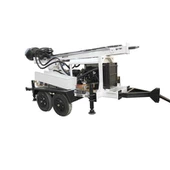
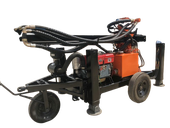
Water well drilling rigs will inevitably fail during construction, which will not only affect the construction progress but also reduce the efficiency of the project. Understanding common problems and mastering the corresponding treatment methods can effectively reduce the occurrence of accidents and ensure the smooth progress of work. The following summarizes several major faults and treatment countermeasures:
1. Drilling stuck
Drilling stuck is one of the most common problems of water well drilling rigs, usually caused by foreign objects (such as sand, steel bars, or small components) entering the well or drilling tools. Improper operation or formation collapse can also aggravate this phenomenon. When drilling stuck occurs, first stop the operation and clean up the foreign objects in the well. If the drill rod is stuck tightly, try to reverse it or use professional tools to assist in unblocking it. For more complicated situations, experienced technicians are required to handle it to avoid damage to the equipment.

2. Failure of drill rod or drill bit
The drill rod or drill bit is worn or broken due to long-term use, or damaged due to improper operation, which will cause the drilling rig to fail to operate normally. In this case, the machine should be stopped for inspection immediately and the damaged parts should be replaced if necessary. In addition, choosing higher-quality tool materials and paying attention to the drilling rig parameters during operation can effectively extend the service life of the equipment.
3. Insufficient drilling rig power and hydraulic system problems
Insufficient drilling rig power is usually related to air pressure or hydraulic system. Insufficient power of pneumatic drilling rigs may be caused by insufficient air pressure. Check whether the air compressor and air pipe are operating normally; hydraulic drilling rigs need to check whether the oil is sufficient and whether the oil pump is operating well. If it is found that the hydraulic system pressure is insufficient, the limit nut can be adjusted or the spring can be replaced. If necessary, the pressure regulating valve sleeve can be disassembled and inspected, and the worn parts can be repaired or replaced.
4. Unable to remove chips
Poor chip removal not only affects drilling efficiency, but also easily causes damage to the drilling rig. The cause of the chip removal problem may be blockage of drill cuttings or poor chip removal function. At this time, the machine should be stopped to clear the chip removal channel and clean the blockage. Increasing air pressure or changing the drill bit model is also an effective solution. In addition, appropriately increasing the air volume during drilling can prevent the occurrence of chip removal problems.
Preventive measures to reduce failures
Although failures are inevitable, the occurrence of problems can be greatly reduced through reasonable maintenance and standardized operation.
- Maintain equipment regularly: check key components, replace wearing parts in time, and clean oil and gas lines.
- Standardize operating procedures: operate strictly by the instruction manual to avoid failures caused by misoperation.
- Make plans for complex strata: fully explore geological conditions and formulate targeted construction plans in advance.

The construction of water well drilling rigs is a highly technical and risky job. The interweaving of human and natural factors often leads to increased complexity of failures. Therefore, operators should continuously improve their professional skills and combine rich field experience to ensure construction efficiency and safety.