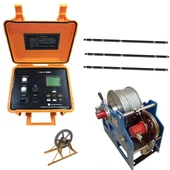
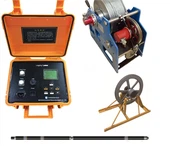
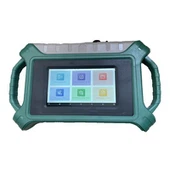
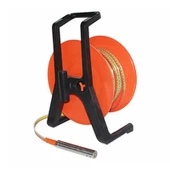
Products Description
Customers in oil, gas, geothermal, mining, and groundwater projects need reliable solutions to quickly and accurately evaluate subsurface formations. RCQ-2D Downhole Logging Tools are designed to meet these needs by providing high-quality measurements of resistivity, porosity, and density. With the RCQ-2D, customers can efficiently identify sandstone reservoirs, locate oil and gas zones, and assess reservoir quality with confidence.
By using this tool, customers reduce uncertainty, make faster drilling decisions, and optimize resource evaluation. The RCQ-2D is a versatile solution for hydrocarbon exploration, geothermal surveys, mining, and groundwater detection, offering complete subsurface analysis for more informed operations.
Products Specification
|
Data Acquisition System |
|
|
Operating environment |
Power:220V, 50Hz Temperature: -10℃~ +50℃ Humidity: ≤ 90% |
|
Depth Counter System |
Depth range: 0-9999.99m Resolution ratio: 0.28mm Speed Range: 0-9999m/h Optical pulse: 3600 pulse/m |
|
Signal transmitting system |
Down hole Signal: Bipolar encoding Communication: RS232 or USB |
|
Figure out the depth of the graph |
1:10, 1:50,1:100, 1:200, 1:500 etc. |
|
The drawing accuracy |
8 points per millimeter (curve) ; 64 pixels per square millimeter (image method) |
|
Borehole Probes ( Sensor) |
|
|
Diameter |
Φ40 and Φ50 mm |
|
Length |
000~1500mm |
|
Material |
stainless steel |
|
Resistance |
20~40 MPa water pressure |
|
Temperature |
Max 70 ~ 90 ℃. Special orders can be 60 MPa water pressure resistance, temperature 120 ℃ resistance. |

Geophysical Logging Probes for Option:
|
No. |
Name |
Parameters |
|
1 |
Resistivity and gamma |
SP, apparent resistivity, natural gamma |
|
2 |
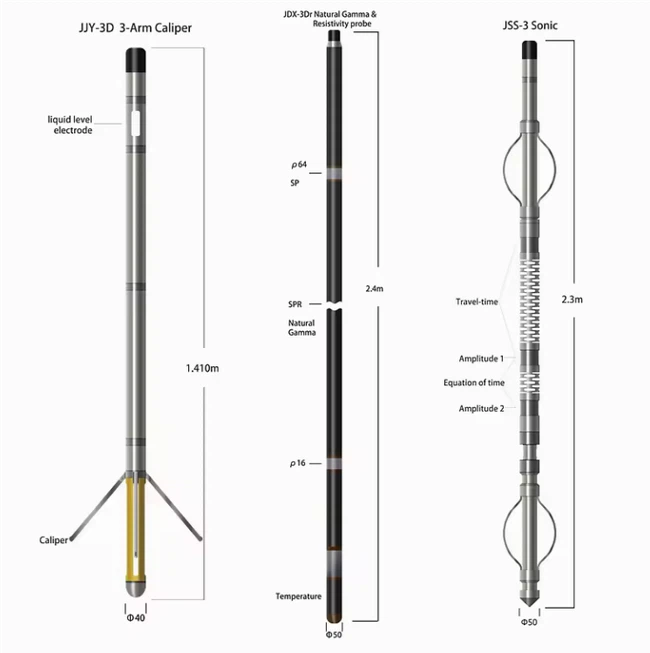
Combined porbe |
16/64 resistivity, SP, natural gamma, temperature, SPR |
|
3 |
RES and IP |
16/64 resistivity, SP, IP |
|
4 |
Three component magnetometer |
Magnetic Tri-component |
|
5 |
Temperature and fluid resistivity |
Temperature, fluid resistivity |
|
6 |
Three-arm caliper |
Diameter, liquid level |
|
7 |
Sonic |
Travel time, equation of time, amplitude |
|
8 |
Combined density |
Density, laterolog resisitivity, natural gamma, sp,caliper |
|
9 |
Neutron and gamma |
Natural gamma, porosity |
Products Features


key purposes of downhole logging tools
Formation Evaluation
Downhole logging tools help in evaluating the potential of a well by providing information about the composition, porosity, permeability, and fluid content of the formations. This data is crucial for determining the presence and quality of hydrocarbons or water, estimating reserves, and assessing the economic viability of a well.
Reservoir Characterization
Downhole logging tools aid in characterizing the subsurface reservoir, including its thickness, extent, and heterogeneity. By analyzing the log data, geoscientists and reservoir engineers can understand the reservoir's structure, identify potential traps or faults, and determine the optimal locations for well completion and production.
Formation Identification
Downhole logging tools help identify and differentiate between different rock formations encountered during drilling. The logs provide information about lithology (rock type), mineralogy, and stratigraphy, enabling geologists to correlate formations across different wells and construct an accurate geological model of the subsurface.

Packaging&shipping
Packaging list:
| RCQ-2D integrated CNC logging tool | 1 set |
| power cable | 1pc |
| Downhole instrument connection | 1pc |
| Photoelectric pulse generator connection | 1pc |
| USB interface cable | 1pc |
|
Calibration line |
1pc |
Shipping:
The downhole logging tool is shipped using reliable and trusted shipping carriers.
The shipping cost is calculated based on the destination and weight of the package.
Customers will receive a tracking number to monitor the status of their shipment.
Delivery times may vary depending on the destination and shipping method selected.
Certificate
Our products have passed CE certification and ISO9001 quality management system certification, ensuring that they meet international standards in terms of safety, reliability and quality.

Logging Technologies
Electrical Logging:
Methods for analyzing the electrochemical properties, resistivity, and electromagnetic wave characteristics of the formation.
Acoustic Logging:
Methods for measuring longitudinal waves, transverse waves, longitudinal wave amplitude, and full acoustic wave trains in the formation.
Radioactive Logging:
Techniques for studying natural gamma, gamma spectra, density, lithology-density, and compensated neutron properties related to the formation's nuclear physical characteristics.
▅ Other Logging Methods: Includes well temperature logging, formation testers, and other specialized tools.
Common logging curves

Main Basis for Identifying Oil, Gas, and Water Layers
The identification of oil, gas, and water layers is primarily based on the principle of the relationship between four properties. Changes in reservoir resistivity are analyzed using logging curves (higher resistivity typically indicates better oil saturation). Formation comparison is used to determine the depth of the interface between oil, gas, and water layers. Primary data, such as logging and core samples, directly confirm the oil content in the reservoir.
The natural potential curve shows an abnormal increase.
Deep detection resistivity decreases, showing characteristics of increased resistance invasion.
Deep and shallow lateral curves exhibit negative anomalies.
The deep detection resistivity value is high.
The natural potential curve exhibits negative anomalies but with a smaller amplitude compared to water layers.
Characteristics of reduced resistance invasion are observed.
Hot Tags: downhole logging tools, China downhole logging tools manufacturers, suppliers, factory, electrical geophysical equipment, electrical resistivity variation measurement equipment, magnetic susceptibility meter, seismic sensors, seismic energy source, gravity data backup software